Category: Articles

  • How to live like a Millionaire?

    How to live like a Millionaire?

    The word Privilege brings out various emotions and the true emotion toward it changes from person to person. For some, it might be enjoying the basic amenities i.ie., needs whereas for others, it might be worldly luxuries i.ie wants. 

    The lifestyle and expenses that come along with privilege are universally classified into NEEDS and WANTS. This concept plays a major role in how we live and how we aspire to live. 

    What is a Privileged Life?

    When someone is more than happy with what they receive and when they receive those privileges easily, compared to the rest of the population, then we can say that they are privileged. 

    It is a perspective that changes from economic status to caste barriers. For example, people who are living pay cheque to pay cheque, the act of dining outside once or twice a month is a privilege. 

    On the other hand, if someone has the chance to start saving more than 20% of their income, then  for them, the act of purchasing an iPhone or Samsung is deemed as a privilege. 

    The biggest form of privilege is the feeling of financial security that lets you take care of your NEEDS and your WANTS without any distress. It is very much possible for individuals to feel that way when they can plan their personal finances or their cash flows smarter. 

    What does it take to live a Privileged Life?

    The secret sauce to living a great lifestyle with little to no stress lies in the act of how you let your money make more money for you. People who are living the privileged life today, have created their own recipe for success using this secret sauce. 

    The effect of compounding in combination with patience is the secret sauce to most of the people that we end up looking up to. No one can deny that and it will stand as a universal truth. 

    Managing your money smartly and investing it in the right avenues is the biggest lesson that you will get to learn from successful people. They never did this alone and they never did this out of luck.The privilege of financial freedom comes when you are consistent and this consistency in success is curated by personalized financial plans & strategies. 
    The Priviledged Life

    The struggles faced by Millionaires in India

    A Lifestyle is created out of sweat and blood. The success stories are spoken out loud by everyone, but no one really knows the struggle behind these success stories. 

    Few inspirational stories that made it to the list are

    1. Dhirubhai Ambani

    Mr Ambani is known for his business conglomerates and he had a very humble beginning. He started by selling Bhajias and also worked at a gas station before creating a powerful company that is managed by his family today.

    1. Dharampal Gulati

    The Masala King of India is none other than Mr Gulati and he is not just popular here in India but has numerous export tie-ups with countries like Europe, USA, Canada and UK. He started his journey in a 14ft X 9ft shop at Karol Bagh in Delhi.

    1. Gautham Adani

    Mr Adani has been making the news for the past 6 months. He came to Mumbai at an early age of 18 years to fulfill his dream. The Adani Group was started with a few hundreds that he had with him at that time.

    There are many more such stories and every single one of them has one thing in common. They were hardworking in their efforts and smart working in managing their personal finances. 

    When you read these stories in depth, you will learn that they got the right loan and made the right investments with the help of financial advisors. 

    A few right decisions turned their life into a privileged one. So, it is not difficult for us all to seek support from Financial Experts to start our money story. 

    Discipline in your Financial journey gives you great returns and it is never too early to follow it. The opportunity to create wealth starts from the moment your parents start giving you your pocket money. 

    Great minds such as Warren Buffet & Charlie Munger started early and planned out their financial journey. A journey that is a great example for us all to follow.
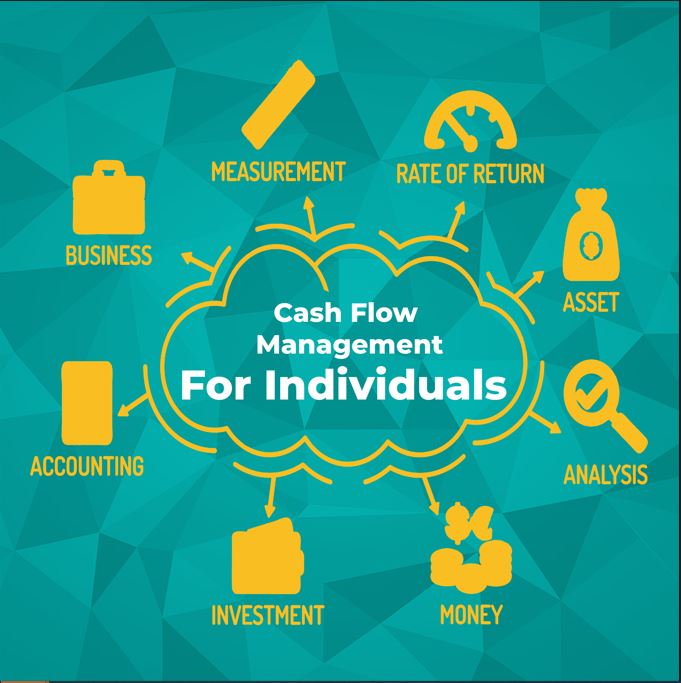
  • Cash Flow Management For Individuals

    Cash Flow Management For Individuals

    Everyone applauds a company for various business milestones that they achieve. It could be their seed round of funding or it could be their first Million. The top gun companies of the world celebrate being the best by following the habit of managing their money better.

    Cash Flow Management is a scientific art of understanding and optimizing the amount of money that is moving into and out of a business. When a company can manage this with maximum accuracy then, you can truly find purpose driven products and services coming out of them. 

    A venture capitalist finds immense pleasure in knowing that their portfolio companies are able to manage the invested money better. They end up calling these companies as companies with brilliant balance sheets. In a way, these companies would know how to plan and manage their money for sustainable long term growth. 

    Why aren’t these ideologies used when it comes to financial planning for individuals? No one really considers looking at an individual’s cash flow at a comprehensive level, except for managing the money held by the super rich. This disparity shown towards the HNIs (High Networth Individuals) by the Financial Advisors has made it difficult for the commoners to build wealth in the most optimized manner. 

    What needs to happen?

    The best financial advisors in the world need to start managing everyone’s money in the most comprehensive manner and this comprehensiveness will come when they start optimizing their cash flow. 

    The thinking has to move away from just working for commissions to working for what is needed for the customer. The certified advisors learn the art of financial planning which includes these comprehensive steps of understanding the customer and then, optimizing the best plan for them. Unfortunately, all those hours of learning simply becomes diluted scripts that will help the advisor earn extra commissions. 

    It’s time for a customer first approach and start with working on an individual’s cash flow to get them a great balance sheet

    What is Cash Flow Management for Individuals? 

    When an individual’s personal finance is broken down into layers, you will notice four layers that play a strong role in their Life’s Balance Sheet.

    1. Income

    What we all earn as salary becomes the primary source of income for all of us and then, there are other passive income sources such as side hustles, rental property income, royalties etc. 

    1. Expense

    What we spend on, be it the needs or the wants. They all fall under our expenses. In practice, expenses are divided into personal, household and family expenses. This level of segregation is common among all.

    1. Investment 

    What we save is what ends up being invested. Normally, our savings are sitting in a savings bank account and earning interest of less than 4% per annum. Some of us take the smart path to save it in tools such as mutual funds, bonds to earn higher return rates.

    1. Loans

    What we owe falls on us as a liability. Loans play a good role in our lives if we plan to get one keeping our future in mind. There are so many avenues to get loans today starting from loans against securities to loans against gold aka gold loan. 

    When these layers are understood and optimized with personalized suggestions then, there is continuous positive growth. The advisory team needs to do this for every single individual and help them with not just investment suggestions but also on how to budget better for themselves and their families etc. 

    Why is this very crucial?

    The market always has its ups and downs. When there is a recession, it is important to have a balance sheet that is protected to withstand the tough times. It is hard to understand the impact of recession in India but it is easy to understand the need to have your balance sheet managed better. 

    The survey conducted by The Week emphasized the need for cash flow management. It stated that the urban population is saving and investing less, while allocating 59% of their income for their expenses. Only 31% of the respondents planned for retirement and the results are shocking as people were dependent on their insurance for their retirement spending. 

    Further, people are heavily dependent on personal loans to make their ends meet post pandemic and this is merely because of lack of discipline in their financial plan. More of these red flags were highlighted by Mint in their survey.

    The Future Ahead

    The Indian economy is strong and taking on every other country along the way. Recently, we went past the United Kingdom and if we have to be a 30 Trillion Dollar Economy, then, we have to uplift the commoners to practice sustainable Financial Habits

    With the help of a team of advisors who can guide them, they can easily start making smart decisions around their cash flow management starting with budgeting, goal planning, and even, with getting an insurance or loan that fits best for them. 

    When fitting solutions find an individual, it reduces leakage of funds from their Life’s Balance Sheet.

  • Basics of Mutual Funds | How to start investing in Mutual Funds?

    Basics of Mutual Funds | How to start investing in Mutual Funds?

    What is a Mutual Fund?

    A Mutual fund is an investment house where investors come together to pool their funds. The fund manager then invests the pooled-in funds in equities, bonds, real estate, gold, and other asset classes to generate higher returns. The gains/losses incurred from such investments are mutually divided among the investors in the ratio of their investments. This is also why it is called ‘Mutual’. Let me explain the basics of mutual fund with an example.

    For instance, you and your friend invest INR 2000 and INR 1000 in a mutual fund. And the gains obtained from the total investment after a month is INR 1500. This is split in the ratio of their investments– 2:1. Which means, you will end up with INR 3000 and your friend with INR 1500 after a month. This idea, when replicated at a larger scale with thousands of investors coming together, is termed a mutual fund.

    Why Mutual Funds?

    • Managed by Experts

    The whole job of fund managers is to safeguard the wealth of investors. Your portfolio is managed by these experts who conduct extensive research and due diligence on buying & selling of stocks. These seasoned finance experts who are skilled in managing investments, decide where and when to invest in equities, debt, gold, and other asset classes. 

    • Higher Returns

    As the adage goes “Don’t put all your eggs in one basket”, mutual funds diversify their investments into different financial instruments. This strategy of diversification has played a vital role in driving the popularity of mutual funds. The fund manager spreads your investment across a cross-section of stocks from companies of different industries. Hence, when one industry doesn’t perform well, the gains from other sectors can offset the losses from the adversely performing sector.

    • SEBI-Regulated

    Mutual funds are regulated by Securities and Exchange Board of India (SEBI), whose main objective is to protect the interests of investors, promote their development and regulate the securities market. It is also SEBI that approves an Asset Management Company to manage funds by investing across industries.

    • Affordability

    You can start investing in mutual funds with as low as INR 100.

    • Liquidity

    Liquidity implies the ease of converting an investment into cash. Liquidity is higher in Mutual Funds. This means, you can sell your investments and pull out the money anytime.

    Categories of Mutual Funds

    Mutual funds are categorized based on the asset class they invest in. Here are the categories:

    Equity Mutual funds

    Equity mutual funds invest a major chunk of their funds in stocks. It is best suited for investors seeking long-term growth as it could be volatile in the short-term. High risk, higher returns. Further, Equity Mutual Funds are categorized into different categories based on the market capitalization of the stocks they invest in. 

    *invests across stocks of different sectors and segments of the market.

    Debt Mutual funds

    Debt mutual funds invest their assets in corporate or government securities like T-bills, Corporate bonds, commercial papers, government securities, and other market securities. This is a lower-risk asset when compared to Equity. Low risk, low returns. They are classified into different categories based on the duration of their investment period. 

    Hybrid Mutual Funds

    Hybrid Funds offer you the best of both worlds. A mix of Equity & Debt. High returns from Equity when the markets perform well and regular income from Debt to cushion the tailwinds when markets go south. The fund manager also invests in Gold & international equities, depending on the investment objective. Since your portfolio becomes diversified, the risk of losing money decreases.

    How to Invest in Mutual Funds?

    • SIP

    Systematic Investment Plan (SIP) is a mode of investment that offers you the option to invest a fixed sum at regular intervals. Instilling discipline in investors, it allows investors to make regular & automated investments periodically. 

    • Lumpsum

    A lump sum mode of investment is when investors make a bulk one-time investment. Unlike SIPs, this is invested in one-go!

    If you’re someone with little to no time to research & identify the right stocks then mutual funds are a good option. You can consult a financial advisor to choose the right mutual fund for you.

  • Impact of Recession on India’s Growth Story

    Impact of Recession on India’s Growth Story

    Off late you must’ve heard talks of recession and how it could affect our country. It’s not just you, the entire world is talking about it, including leading economists, global news channels, big investors and major investment banking companies. Before we talk about impact of Recession on India, let’s first understand what it is.

    What is a Recession?

    By definition, a Recession is when a country’s economic growth slows down or shows a negative trend for two continuous quarters (GDP). In simpler terms, people have less money to spend, which leads to reduced business activity and eventually more people lose their jobs. 

    COVID lockdowns have affected every single country on the planet. It’s been two years now and we are still fighting to get back to normal. Adding to this, we now have the Russia-Ukraine conflict, which has impacted the entire supply chain of the global economy, further increasing the inflation in every country.

    Major factors which lead to Recession

    1. High Inflation
    2. Excessive Debt 
    3. A sudden disturbance in the economy like covid, financial crisis – 2008 etc.

    A recession doesn’t happen due to a single factor, and also it doesn’t happen overnight. Various factors influence a recession. For example, COVID and the war have affected every single economy. Countries like Srilanka, Argentina, Japan, and Italy are under excessive debt. 

    We live in the era of globalization and the world is one big family. If one country goes down due to recession, then there is a domino effect affecting several other nations. Financial experts from Deloitte, Morgan Stanley, Citigroup, JPMorgan Chase, Credit Suisse, S&P Global Ratings, Goldman Sachs and Deutsche Bank have predicted that the US will go into recession in the upcoming quarters.

    As we speak, the US is the largest economy. If the US goes into recession, then it will have cascading effects on almost all the countries. We have seen this in the past. For example 1933 – Great Depression and the 2008 – financial crisis.

    As unemployment rates are one of the key indicators for an economy to be under recession. The figures are showing positive in the US, but the two-quarter GDP result says that the US is technically under recession.

    Impact of Recession on India

    Impact of Recession on India

    Source – Economic Times

    India’s GDP growth forecast is above 7.4% for FY 2022-2023. This is enormous when compared to other major economies like the US, China etc. The average inflation rate in India for the past 10 years is from 5% to 6% which is slightly increased to 6.71% (as per June 2022 data). At the same time, average inflation for countries like the US, and Europe is between 2% to 4%, which has now drastically increased from 7% to 9%. 

    As Federal communities started increasing their interest rates in March 2022, and it is believed that the rate hikes are expected until the end of next year to ease the inflation in the US, which will make every other country increase the interest rate including India. As per LiveMint  Federation of Indian Chambers of Commerce & Industry (FICCI) says Inflation in India is predicted at 6.7% for FY 22-23, and it is expected to come down to 4% in June 2023 considering the upcoming repo rate hikes in India.

    The major impact of the recession will be on India’s exports if countries like the US, and China go under recession as India stands in a better place in terms of food security, forex reserves etc, According to Trading Economics china takes care of 16% of total imports in India, whereas the US takes care of 6% and United Arab Emirates (6 percent), Saudi Arabia (5 percent) and Switzerland (5 percent). 

    At the same time, this will get offset by lower commodity prices like crude oil. India’s major import is crude oil & gold which occupies 85%. If a recession affects the major countries the crude oil price will ease. For example –  in the 2008 financial crisis, the price of one barrel of crude oil was US$147 and due to the recession, it came down to around US$36 per barrel.

    USD/INR and Unemployment

    Recent factors have led INR to trade at an all-time low against the USD, affecting our imports. RBI is taking necessary steps like increasing interest rates, controlling inflation and swapping US currency for INR to increase the demand for INR in the global market.

    Although the pandemic has impacted global economies, India has a different story to tell, especially on unemployment. As per Economic Times, India’s unemployment rate was at 6.1% in 2017-18, 5.8% in 2018-19, 4.8% in 2019-20 and further reduced to 4.2% in 2020-21. 

    In all honesty, the data shows that even though we are in the middle of a global crisis, India is in a better position when compared to developed and developing economies.

  • How to pick the right Mutual Fund for you in 2022? 

    How to pick the right Mutual Fund for you in 2022? 

    Mutual funds have been proven to be a very successful way to begin one’s investment journey. As an investor, it’s the best investment avenue to begin your journey without having to know much about equity markets, indexes or even how the economy is performing.

    But as a new working individual I personally struggled with picking the right fund. And not surprisingly I, like many of you, would google “Best mutual funds for highest returns”. But is that really the right way to go about a personalized suggestive option?

    Of course not!

    But don’t worry, you don’t have to go through the same struggle I did.

    How to select right mutual funds?

    Investments are not a ‘One size fits all’ type of assets. They are supposed to be personalized based on your expectations, needs and comfort levels. Hence, these are some of the points that you should keep in mind while selecting a suitable fund for yourself:

    Right Mutual fund in 2022

    1. Your Personal Objective – Be mindful of what you are trying to achieve with your investment. Whether it’s a foreseeable major expense like your wedding, a future trip abroad, an emergency fund, your child’s education, your retirement, or even something for your family, make sure you have a clear reason for this investment.

    This objective will help you decide 2 things

    a) A timeline – What your investment’s duration should be.

    b) How risky/ risk-free should you be in order to choose the fund.

    2. Risk Appetite- Risk is a very interesting point here. People between the ages of 22 to 28 are generally ‘risk seekers’. To state the obvious, these are people who in general have lesser debt, lower obligations and have the bandwidth to take on additional risk.

    There after funds that contribute to over 85 to 90% of the funds AUM* to just equity. This makes the fund riskier but it is able to generate higher returns too. (Remember, an investor always looks for additional compensation when he takes more risk. Hence, a high risk to high reward ratio is seen amongst different funds)

    Now, for people over the age of 29, Risk becomes a critical factor. People in this age bracket are generally more cautious about their finances because of responsibilities, debt and other things.For them a fund that has a good balance of both Equity and Debt is preferrable. 20 – 35% of AUM may be dedicated to Debt funds making the fund safer & more stable.

    3. A Suitable Fund – Now that you have a goal in mind with the required time line and risk appetite, look for funds that help you reach the required returns percentage. 

    How do you do that? Well, an easy way is to compare the returns percentage that the fund has made over the required tenure (for eg say 3 years) to the returns made by the Indian Indexes such as Nifty & Sensex. If your fund beats or equates that return percentage, you are good to go. 

    For Example – My 3-year goal is to buy a car for  X amount of rupees. My money has to grow at a continuous interest rate of 15%. I would look for a fund that has been consistently performing well and one that gives me a return of at least 20% CAGR*.

    Types of Funds:

    • Equity Schemes – These are funds that are high risk and have a high return potential. These are ideal for investors in their prime earning stage, looking to build a portfolio with superior returns in the long term.
    • Money Market Funds – These are funds that invest in short term debt instruments, giving a sustainable and stable return. These types of funds are suitable for investors with low risk who are looking to park their surplus over a short term.
    • Fixed Income or Debt Funds – These funds would have majority of their investment in debt instruments such as government securities (G-sec), bonds and debentures. Ideal for low-risk investors who are looking for a steady income.
    • Balanced and Hybrid Funds – Funds that have a good mix of both Equity and debt. The allocation of the AUM would keep changing based on how the sectors are performing in the current market sentiment. Since it’s a combination, the returns would be moderate to high depending on the allocation.

    So do your research to identify the right mutual funds that match with your expectations, needs and comfort levels. 

    If you find this whole process overwhelming, you can always hire an Advisor who can help you with this!

    Glossary

    AUM – Asset Under Management means the total value of the fund being invested by the fund house.

    CAGR – Compounded annual growth rate is the annualized average rate of revenue growth between two given years, assuming growth takes place at an exponentially compounded rate.

    NAV – The performance of a particular scheme of a mutual fund is denoted by NAV (Net asset value). NAV is the market value of securities held by the scheme.

  • Why is SGB the best option to invest in Gold?

    Why is SGB the best option to invest in Gold?

    Alongside China, India is by far the world’s largest importer and consumer of gold. Gold is one of the most preferred investments in India. With over 95% of Gold being imported, the yellow metal turns adverse to India’s forex reserve. To address this problem, Government of India launched Sovereign Gold Bonds (SGBs) in 2015 under the ambit of the Gold Monetisation Scheme.

    The objective of the scheme was to cut down the demand for physical gold and shift a part of the domestic savings (used for the purchase of gold) into financial savings. 

    SGBs are government backed securities, issued by the Reserve Bank of India (RBI) on behalf of the Indian government. Investors have to pay the issue price and the bonds will be redeemed upon maturity.

    How to buy Gold Bonds? 

    SGBs can be ordered through the Net-banking option of banks, from designated Post Offices, Stock Holding Corporation of India Ltd. (SHCIL) or even through authorized stock exchanges. Investors can also download the application from RBI’s website or through bank sites.

    Sovereign Gold Bond
    Sovereign Gold Bond

    Who can invest through SGBs?

    “Residents” in India as defined under Foreign Exchange Management Act, 1999 are eligible to invest in SGBs. Eligible investors include individuals, HUFs, trusts, universities and charitable institutions. Joint holding is allowed in SGBs. For minors, the application has to be made by his/her guardian(s).

    Can NRIs invest in SGBs?

    Only residents of India are eligible to invest in SGBs. Individual investors with subsequent change in residential status from resident to non-resident may continue to hold SGBs until early redemption/maturity.

    SGBs vs Physical gold


    SGB vs Gold
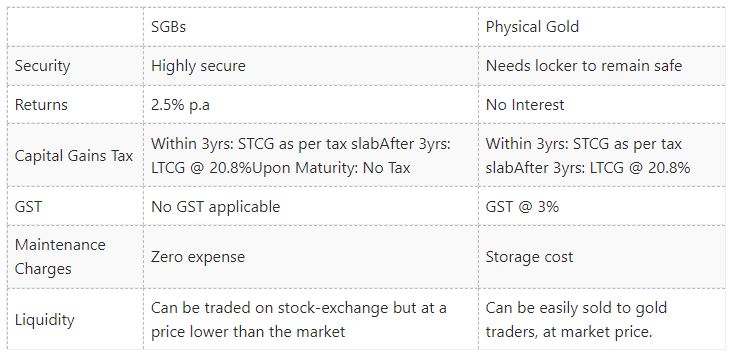
    • SGBs offer a superior alternative to holding gold in physical form since the risks & costs of storage are eliminated. SGBs are free from issues such as making charges and purity in the case of gold held in the form of jewelry. 
    • The flip side of SGBs is their fixed lock-in period. SGBs are issued for a fixed term of eight years with an option to redeem them from the fifth year onwards at the RBI buyback window.
    • Also, if gold bonds are sold prematurely on the stock exchange before three years, then they will attract short-term capital gains tax (STCG) as per the investor’s slab rate. But if they are sold after three years, then long-term capital gains tax (LTCG) of 20 per cent will be applicable, and the investor will also get indexation benefits. And, if one were to hold the bonds until maturity, or until the RBI buyback window, then capital gains tax will not be applied. 

    Price of Sovereign gold bond

    The Reserve Bank of India (RBI) fixes the issue price per gram for each tranche by calculating the simple average of the closing prices of 999 purity gold as disclosed by Indian Bullion and Jewellers Association (IBJA) on the last three working days before the week marked for the subscription.

    Our Take

    Buying gold jewelry isn’t an investment. But if the idea is to remain invested in Gold, then SGB is the best option in the market. Along with capital gains, investors are paid interest rate. NO GST during purchase and NO Capital gains tax on sale. And also, India need not shell out dollars from its reserve. It’s a win-win situation.

  • What are GOLD ETFs? When should you buy them?

    What are GOLD ETFs? When should you buy them?

    For centuries gold has proven to be a safe investment bet. Indians, when compared to people in the rest of the world, have felt great comfort when investing in this yellow metal. Often, this investment is in the form of jewelry and not other digital forms like Gold ETFs or Bonds. Although, investment in physical gold has created other challenges for us. As India does not produce gold in significant quantities, we have begun to rely on imports.

    People began to accumulate Gold for safety purposes as their Long-term investment strategy. Some professionals today say that Gold is a great tool to hedge against inflation. Large scale gold imports, especially for investment created a higher Trade Deficit (this happens when imports far exceed exports). When this happens the rupee comes under pressure and tends to weaken. This sets off many more problems for the Indian economy.

    To avoid this situation and push people to look beyond investing in just Physical Gold, the Government of India came out with Gold Exchange Traded Funds (ETFs) apart from Sovereign Gold Bonds (SGB).

    Now….What is a Gold ETF?

    A Gold ETF is an exchange-traded fund that aims to track the domestic price of physical gold. In other words, Gold ETFs are units representing physical gold either on paper or in dematerialised forms. Typically, one Gold ETF is equal to 1 gram of gold. Meaning, 1 unit of Gold ETF is backed by an equivalent quantity of physical gold. Gold ETFs give you a combined benefit of investing in Stocks as well as Gold.

    They are listed and traded on the National Stock Exchange of India (NSE) and Bombay Stock Exchange Ltd. (BSE). And just like the stock of any company that can be bought & sold continuously at market prices, Gold ETFs can be treated the same way.

    However, when you actually sell your Gold ETF, you don’t get physical gold, but receive the cash equivalent of the market price.

    How are Gold ETFs Beneficial to you?

    • Transparency – The biggest benefit is the transparency in pricing as it is directly linked to the price of gold. 
    • Cost – ETFs incur far lower expenses compared to physical gold where one ends up paying wastage charges, making charges, safe storage cost etc. 
    • Safety – Unlike physical gold the investor need not worry about the investment’s safety. ETFs not only fetch the same return as physical gold but are also a lot safer than its physical form as there is no fear of theft or depreciation.
    • Loan – Gold ETFs can be placed as a collateral to secure loan from any financial institution.

    Where can you purchase Gold ETFs?

    Gold ETFs can be purchased through a stock broker like Zerodha, Sharekhan and other investment apps. You will have to pay a small brokerage or fund management charges while buying or selling Gold ETFs. As  mentioned earlier the overall cost is much lower than what an investor incurs in buying physical gold and there is NO better time to invest in Gold than today.

    Gold ETFs Vs. SGB

    Many of you might have a pondering question on how Gold ETFs are different from SGBs. Well here’s our take of the same. 

    gold etfs

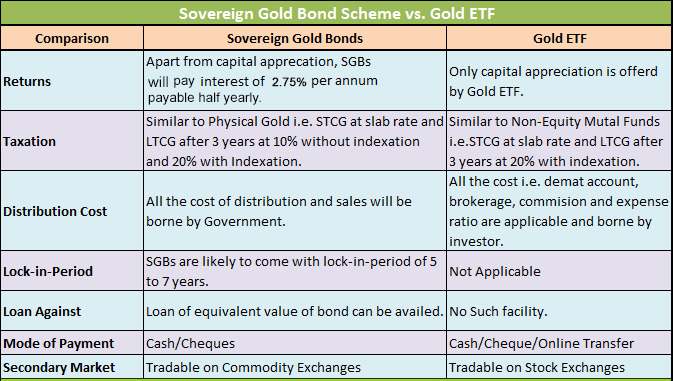
    The advantage that ETFs have over SGB is that they are more liquid. They can be sold at any given time like stocks. An investor need not hold onto their investment for a fixed period. Although ETFs are taxable.

    If you prioritize your investments based on safety and liquidity, then Gold ETFs are your safe haven.

  • 6 Reasons to Choose Personalized Financial Plan

    6 Reasons to Choose Personalized Financial Plan

    Many customers are left disheartened by the financial products that they have purchased. It could be anything from Fixed Deposits to Term Insurance. Everyone has their own reasons but the majority of the problem stems from the fact that products don’t meet customers’ requirements. 

    For some, Impulse buying is the main reason and a reward based credit card is a good example of this. For others, it is the same old enemy – the concept of motive-driven selling by financial agents.

    Clearly, society longs for a better solution, and web traffic on financial planning & financial advisory, suggests the same. Adding to it, the pandemic has made customers realize that the world of VUCA is here. They were in dire need of help from financial experts to guide them through these confusing times. 

    What is VUCA? 

    • V – Volatility 
    • U – Uncertainty
    • C – Complexity
    • A – Ambiguity 

    If someone shouts “it’s crazy out there” then, we can strongly believe that they are talking about the VUCA world. It is predominantly used to describe a situation that is difficult to comprehend. Predicting the outcomes of our decisions is tricky during this situation. More on VUCA here.

    What are the advantages of a personalized financial plan? 

    → Creating a Sustainable Financial Plan

    It is very important to start with a plan. Without understanding your current situation and caliber of risk, it would be fruitless to plan your financial journey. The Rich capitalizes on advisory service by providing their goals and targets so that they can enjoy life without falling short of funds. 

    → Delighting with Customer Satisfaction

    The feeling of being listened to is something that everyone loves. Through personalization, the best financial advisor in town would concentrate on listening to the customer and then, providing them with customized financial solutions. This curated solution helps with steady growth and will certainly leave a smile on your face.

    → Building Corpus for Goals

    Financial security is a reality when there is little or no stress about our monetary situation. To get into this secure headspace, we have to find ways in which our money can make money to help achieve our goals. Power of compound interest along with the guidance of a financial planner will do wonders in this world. 

    → Attaining Mental Peace

    Confidence and the positive mindset to tackle the day comes from feeling mentally secure. Overthinking about money will push everyone’s mental health to the edge. Personalization can certainly help in passing over the burden of stressful decisions to an expert.

    → Maintaining your portfolio

    Getting a customized financial plan is just the beginning of personalisation. The plan should always include regular check-ins and restructuring of the plan so that your money story is moving in the right direction. A good financial advisor will recommend reallocation or restructuring every 3- 4 months.

    → Higher ROI 

    It is easy to start your financial journey with the content from generic news and also, free advice on YouTube or MoneyControl. But this is not going to be as powerful as the one that is designed through personalization. The return on investment is higher because you are connecting your hard-earned income to your needs and wants.

    Why is a Personalized Financial Plan crucial?

    • To steer the customers through the right financial journey, they require an expert who can understand their needs and wants. Someone who can shine a light on their financial plan by personalizing it to their needs and wants. Someone who will guide them to see their financial success.
    • A combination of understanding and listening to the customer is the inception of personalization. Today, there is less listening and more selling that is happening. 
    • Pampering the consumers with misfit solutions that have short-term benefits. Clearly, there is a lack of sustainable planning because products like credit cards, buy now pay later, instant micro-loans, etc. are helping them with their short-term needs and wants.
    • Sustainable financial planning will always be a customer-first approach and will be completely designed to help the consumer get the best mutual funds, best ELSS funds, best bonds, etc based on their goals. A certified financial advisor creates a higher level of trust, comfort, and comprehensiveness.

    In a nutshell, people who are hunting for the answers around best mutual funds or best way to invest in gold can tweak their habit to include personalization and get themselves a strong advisor. When they do so, they will not only find answers for their questions but also find that wealth creation is easy with more people working together hand in hand.

  • How To Escape From Motive Driven Selling

    How To Escape From Motive Driven Selling

    A busy yet gloomy Monday morning filled with chaos to get to work in time right when the phone rings and an unknown number flashes on the phone screen. From experience, you know you shouldn’t pick upt, yet, you do with the hope of it being relevant and useful. The first few words that you hear might sound like this, “I am calling to inform you that you have a pre-approved loan…” or “you have been approved for a free credit card…” The intent of the call might be different every day but the general tone will give you a picture of the person on the other side.

    Why Sales people want you to buy their product?

    In the Banking, Financial Services, and Insurance sector, “cold calling” is used as a sales method to sell loans, credit cards, or insurance products. A process that is very important in the sales cycle of an Insurance Agent, Loan Agent, or Credit Card Agent. This call that you happen to answer  is their opportunity to convince you to try their product. If you contemplate buying one of these, then, that gets them excited. You might wonder why? Some of you might already know the answer to this. The answer is that you helped them get a hefty commission by just agreeing to take the product that you might not truly need.

    What is a good financial product sale?

    There is nothing wrong with getting a reward for a good sale. A good sale is nothing but understanding your needs and goals before suggesting the product to you. The trait of a good sale would be to give you options: these are the best credit cards out there for you or this insurance covers all your medical needs for the next 10 years. If they listen to you and understand, they can suggest better financial products.

    What is going wrong with their sales pitch?

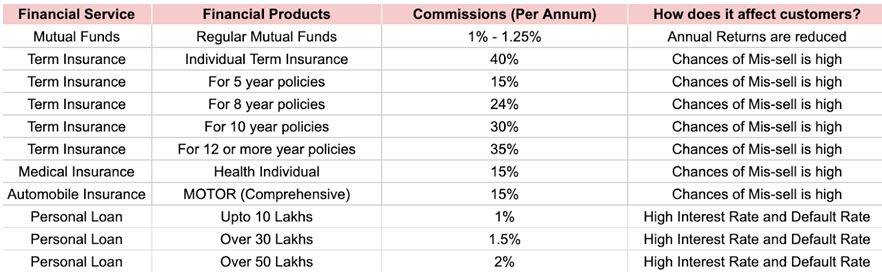
    Unfortunately, their scripts find themselves bunched up differently. The sales team’s script needs to start with understanding your situation and then, recommend the product that fits well in your financial plan.  Instead, they are in a rat race to mis-sell term insurance or health insurance, or even a loan, just for the sake of commission.

    Do we truly have an option to find the right financial product?

    There is a growing trend for people to look for a financial consultant to guide them with the right financial advice. This is to stay filtered from the ones who are behind those calls with an elaborate script to persuade and sell the highest commissioned product to you.. This mis-selling behavior in the banking sector or BFSI sector has been reported several times in the past. The study conducted by The Economic Times clearly talks about how dealing with them is the only option. This is indeed reality as your personal data is being pushed even into the smallest banks, where you have never had any transactional relationship. These make you highly exposed and vulnerable and are cornered by your own trusted banks/NBFCs.

    Going Above and Beyond for a smarter Financial Decision

    A good sale always leads to more referrals and definitely helps the financial institutions to supercharge their growth. But now, the opposite is happening where customers are warning their friends & family about the annoying, daily sales calls. Until the sales agent realizes the secret power of value selling, you as a consumer have to be smart with your filtering process to get the best financial products.

    These are a few tips that can help us decide what product to get.

    • Research on options that will match your needs – Be it Insurance, Loans, or Credit Cards, today we can quickly access the information on the internet and get extensive research done on key metrics needed to buy a suitable financial product.
    • Find the one that is affordable – Always understand our appetite and find the product that we can afford without hindering our lifestyles. It wouldn’t be wise to compromise on other life-altering decisions based on a bad financial decision.
    • Learn about the fine prints – It is crucial to read between the lines and understand the hidden and invisible conditions associated with the chosen financial product. If we don’t know what to ask, we can start learning from communities that promote financial literacy. There are plenty of educational resources available to help us cultivate this best practice.
    • Seek Assistance from Financial Experts – Always have some trusted individuals who are preferably experts in this field. This could help us benefit and sometimes even exploit (in a legal way of course!) our financial system and achieve your goals. An expert who can provide guidance in everything ‘money-related’.

    In time, such customers will evolve to take right decisions on their own with experience and/or with external guidance from advisors. When that time comes, most of these insurance brokers, loan agents, and credit card resellers would find it challenging to trick customers into purchasing a product unsuitable for their financial needs. Until then we have to protect ourselves with knowledge that will help us distinguish the good from the bad. A good place to start would be on vittae.money, where we can learn from your own community The content shared will help us upskill and stay informed on the products and other regulatory methods proposed by the Reserve Bank of India.

  • Is It The Right Time To Start Gold Investment?

    Is It The Right Time To Start Gold Investment?

    Gold Investment is considered to be an all weather investment. More than an investment, Gold is treated as an insurance for all the other investments. It is a hedge against inflation.

    During an economic downturn while asset classes such as stocks, mutual funds and real estate may tumble, Gold would still sustain and outperform them. This is the reason why portfolio managers always insist on having a fair share of your investments in gold.

    Gold_Investment

    Today, we see the stock markets across the globe have become more volatile due to geo-political tensions with Russia- Ukraine conflict and stringent covid-lockdown in China. Fears of economic recession and increase in Fed rates has created the perfect situation for gold to skyrocket again.

    Is this the right time to invest in gold? Ideally, yes. Stock markets are down, cryptos have crashed and real estate is yet to recover. Gold at its present value looks attractive. Experts believe people will shift their focus to gold if stock don’t recover soon.

    Gold’s performance in the last 20 years

    The annualized return from march 2000 to march 2020, Nasdaq 100 had a return of 2.5 percent, S&P 500 gave a return of 4 percent whereas gold gave a return of almost 9 percent. 

    In 2020, gold delivered an annual average return of 24.6 percent. Over the last 40 years gold provided an average annual return of 9.6 percent and negative returns only at 8 instances. 

    Stock Vs Gold performance during the economic crisis

    During the 2008 global financial crisis, while the stock market fell as much as 60 percent, gold remained unaffected and in fact it grew by 6 percent. The same would be visible with multiple other crisis situations like the East-Asian crisis. 

    This clearly indicates that gold is a safe bet when it comes to economic downturns. 

    How to start gold investment? 

    There are multiple options to invest in Gold like buying physical gold, Gold ETFs or Sovereign Gold Bonds (SGBs). 

    • Physical Gold can be purchased in the form of coins or bars. Buying jewelry isn’t an investment.
    • A gold ETF is a type of ETF that can be purchased or sold on a stock exchange like any regular stock. The option eliminates storage costs & security risks of holding physical gold but comes with an expense ratio and Capital gains tax.
    • SGBs are substitutes for holding physical gold. SGBs are less risky as they are guaranteed by the government. But there is more to add, these bonds offer 2.5% interest and NIL Capital Gains tax if they are redeemed by completing the term(8years).

    Options like SGBs and Gold ETFs are termed as Paper-Gold which obviates the need to buy physical gold and store them while assuring the same return.

    If the World Bank & IMF are to be believed, the global economy is slowing down significantly due to covid and geo-political tensions. Global trade has shrunk. And stocks, mutual funds, cryptos, real estate will see a major correction. Smart investors looking for better investment options would definitely find gold as their best bet. So it’s time for you to become smart by starting to invest in gold.